TL;DR:
An ADU for aging parents costs $100,000 to $175,000 to build once. Assisted living in Idaho runs $3,800 to $5,200 per month, or $46,000 to $62,000 per year. Over five years, that's $230,000 to $310,000. The ADU pays for itself in two to four years, keeps your parents close, preserves their independence, and adds lasting value to your property. But it only works if the design accounts for aging from day one. Zero-step entries, 36-inch doorways, curbless showers, wall blocking for future grab bars, and lever hardware aren't luxury upgrades. They're the features that determine whether your parent can live in the unit for three years or fifteen. This guide covers the financial case, the design details that matter most, and the Twin Falls-specific considerations you need to plan for.
There's a conversation happening in kitchens across the Magic Valley that nobody talks about publicly. Mom is getting older. Dad's balance isn't what it used to be. The family is trying to figure out what comes next, and none of the options feel right. A nursing facility feels premature and impersonal. Moving them into the guest bedroom sacrifices everyone's privacy. Doing nothing and hoping for the best isn't a plan.
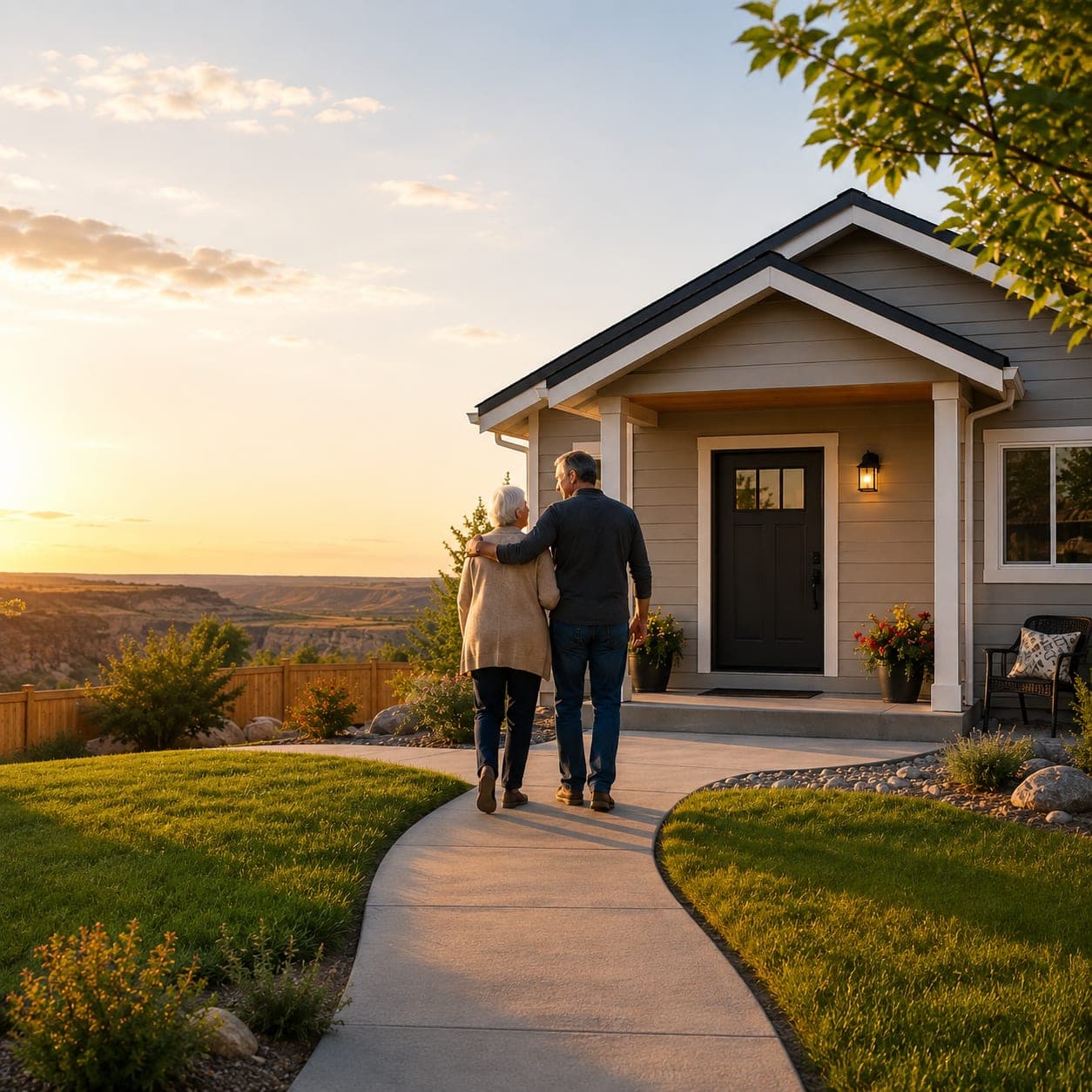
An ADU in your backyard is the option that most families don't realize exists, or assume they can't afford. In reality, it's often the most financially sound and emotionally healthy solution available. But only if it's designed correctly from the start.
The Financial Case: ADU vs. Assisted Living in Idaho
Let's start with the math, because the math is what usually surprises people.
Assisted living in Idaho currently averages $3,800 to $5,200 per month depending on the data source, level of care, and location within the state. Twin Falls is on the more affordable end, but families should still plan for $3,500 to $4,500 per month for a basic assisted living unit. That's $42,000 to $54,000 per year. Over five years, you're looking at $210,000 to $270,000, and that number only goes up as costs continue to rise 3 to 7% annually.
A detached ADU in Twin Falls costs $100,000 to $175,000 to build, depending on size, finishes, and site conditions. That's a one-time cost. There are no monthly facility fees, no rate increases, no surprise charges for additional services. You'll have ongoing expenses (property tax increase of roughly $50 to $90 per month, utilities, and maintenance), but those total $200 to $400 per month at most.
The breakeven point is clear. At $4,000 per month for assisted living versus a $140,000 ADU with $300 per month in ongoing costs, the ADU pays for itself in approximately three years. Every year after that, you're saving $40,000 or more compared to the facility option.
And unlike assisted living, the ADU is an asset. It adds value to your property. When it's no longer needed for a parent, it becomes a rental unit generating $900 to $1,100 per month, a guest house, or a selling point that increases your home's resale price.
Why This Isn't Just a Financial Decision
The numbers make the case, but most families aren't making a spreadsheet decision. They're making an emotional one. Here's what an ADU offers that a facility can't:
Proximity without cohabitation. Your parent is 30 feet away, not 30 minutes away. You can check in daily without scheduling a visit. They can join family dinners without it being an event. But at the end of the evening, everyone goes to their own space. That boundary matters for long-term family health.
Independence and dignity. Your parent has their own kitchen, their own front door, their own schedule. They're not a resident in someone else's building. They're a homeowner's parent living in a real home. For many older adults, that distinction is the difference between thriving and declining.
Continuity of community. Moving to an assisted living facility often means leaving the neighborhood, the church, the friends, and the routines that give life structure. An ADU keeps your parent in a community they already know, with the support of family next door.
Flexibility as needs change. An ADU can start as a fully independent living space and gradually accommodate more support as needed. Grab bars can be added. A caregiver can visit. The unit can evolve with your parent's needs without requiring another move.
Design Features That Actually Matter for Aging in Place
This is where most ADU projects for aging parents go wrong. Families build a nice unit but don't think about what their parent will need in three, five, or ten years. The features below aren't about meeting code requirements. They're about building a home that works for a 72-year-old today and an 85-year-old tomorrow.
Entries and thresholds
Zero-step entry is non-negotiable. At least one entrance must be flush with grade, with no step-up, no lip, and no threshold to trip over. This means planning the foundation height and the approach pathway together so the transition from outside to inside is completely level. A small covered porch over the entry protects against rain and ice, which matters in Twin Falls winters.
If a ramp is needed later, design the approach with enough run to accommodate a 1:12 slope (one inch of rise for every twelve inches of length). A 6-inch step requires a 6-foot ramp. Plan the landscaping and pathway to leave room for this, even if you don't build the ramp now.
Doorways and hallways
36-inch interior doorways throughout. Standard residential doors are 30 to 32 inches wide. That's too narrow for a wheelchair, a walker, or even someone moving carefully with a cane. Upgrading to 36-inch doors during construction costs very little but makes the entire unit accessible for life. ADU design experts at BuildX emphasize that this is one of the most impactful and inexpensive decisions you can make.
Hallways at 42 inches minimum. If the layout includes a hallway (many ADU floor plans avoid them entirely with open layouts), it needs to be wide enough for a turning radius.
Lever handles on all doors. Round knobs are difficult for hands with arthritis or reduced grip strength. Lever handles open with a push, not a twist.
Bathroom design
The bathroom is where falls happen. It's also where the most critical design decisions are made.
Curbless (roll-in) shower. No step, no lip, no threshold. The shower floor is flush with the bathroom floor and slopes gently toward the drain. This eliminates the most common fall hazard in any home. A built-in shower bench (either fixed or fold-down) provides a resting option.
Wall blocking throughout the bathroom. This is the single most important hidden feature. During framing, install 2x8 or 2x10 solid wood blocking at 32 to 36 inches high on every bathroom wall. This provides a solid mounting surface for grab bars wherever they might be needed in the future. Blocking costs almost nothing during construction but saves thousands compared to retrofitting later. Without blocking, grab bars must be mounted with toggle bolts into drywall, which can pull out under load if someone actually falls.
Comfort-height toilet. Standard toilets sit at 15 inches. ADA-height toilets sit at 17 to 19 inches, which is significantly easier to sit down on and stand up from. This is a $50 upgrade at purchase that makes a meaningful daily difference.
Handheld showerhead on an adjustable slide bar. Works whether standing or seated. Simple, inexpensive, and dramatically improves usability.
Kitchen and living space
Open floor plan. Minimize walls between kitchen, dining, and living areas. Open layouts improve mobility, allow a wheelchair or walker to move freely, and make the small footprint of a typical ADU (500 to 700 sq ft) feel more spacious.
Induction cooktop instead of gas. No open flame, no gas leak risk, and the surface doesn't stay hot after cooking. Induction cooktops are recommended by aging-in-place specialists at Otto ADU for households with cognitive concerns or dementia risk. They're also faster and more energy-efficient.
Counter and cabinet accessibility. Lower a section of kitchen counter to 34 inches (standard is 36) for seated use. Install pull-out shelves in lower cabinets instead of fixed shelves. Use D-shaped cabinet pulls instead of small knobs.
Good lighting everywhere. Aging eyes need more light. Under-cabinet lighting in the kitchen, motion-activated nightlights in the bathroom and hallway, and well-lit pathways from the bedroom to the bathroom. Dimmer switches on overhead lights give control without the harsh on/off transition.
Smart home features
These add minimal cost during construction and can make a meaningful difference in safety and daily living.
Smart lock on the front door. Keypad or phone-controlled entry eliminates fumbling with keys. You can also unlock remotely if your parent is expecting a caregiver or delivery.
Video doorbell. Lets your parent see who's at the door without getting up. Also lets you monitor activity from the main house.
Voice-controlled lighting. "Turn off the kitchen lights" is easier than walking across the room to a switch, especially at night.
Medical alert integration. Ensure the unit has strong WiFi coverage and cellular signal for wearable medical alert devices.
The "Invisible Accessibility" Approach
Here's a principle worth adopting: a well-designed aging-in-place ADU shouldn't look like a medical facility. The goal is a home that's beautiful, comfortable, and happens to be fully accessible. Grab bar blocking is hidden inside the walls. Curbless showers look like modern design choices (because they are). Lever handles and wide doorways are standard in contemporary architecture. Induction cooktops are sleek.
SnapADU's aging-in-place guide captures this well: even if the bathroom is built to be ADA-compliant, it doesn't have to look like it is. You want it to look really nice and at the same time allow your parent to live there as long as they possibly can.
Your parent shouldn't feel like they're moving into a care facility. They should feel like they're moving into a really nice small home that happens to work perfectly for them.
Twin Falls-Specific Considerations
A few local factors that affect ADU projects designed for aging parents in the Magic Valley:
Winter accessibility. Twin Falls gets snow and ice from November through March. The pathway between the main house and the ADU needs to be shoveled, salted, or heated. Consider a covered walkway or a pathway material (concrete with broom finish for traction) that minimizes slip risk. Covered entries aren't optional in this climate.
Single-story only. For an aging parent, a single-story ADU is the only practical option. This aligns well with Twin Falls code, which limits detached accessory buildings to 15 feet in height under reduced setback rules. Most aging-in-place ADUs are well within that envelope.
Shared utilities. The Twin Falls code requires ADUs to share water, sewer, and sanitation with the primary dwelling. This means your parent's unit will be on your utility bill. Budget for the incremental increase (typically $100 to $200 per month for a single occupant) and decide upfront whether you'll absorb it or work out a cost-sharing arrangement.
Size cap. ADUs cannot exceed 45% of the principal residence's living space under current city code. However, SB 1354 (effective July 1, 2026) raises the floor to 1,000 sq ft or 75% of the primary home. For aging-in-place units, 500 to 700 sq ft is the sweet spot. Large enough for comfortable independent living, small enough to be manageable and affordable.
A Note on Legal Protection
If you're building an ADU for a parent, consider having an attorney draft a life estate or lease-for-life agreement. This protects your parent's right to remain in the unit even if circumstances change (divorce, financial difficulty, property sale). BuildX recommends this as standard practice for family ADU situations, and it's a conversation worth having with a local estate planning attorney before construction begins.
This isn't about distrust. It's about making sure everyone's interests are protected in writing while the family relationship is strong and the conversation is easy.
Frequently Asked Questions
Does a private ADU need to meet full ADA standards?
No. The Americans with Disabilities Act applies to public accommodations, multifamily housing, and publicly funded projects. A private single-family ADU is not legally required to meet full ADA standards. However, incorporating universal design principles (zero-step entries, wide doorways, curbless showers, blocking for grab bars) is strongly recommended for any unit intended for aging in place. These features cost very little during construction and make the unit functional for decades.
What if my parent's needs increase beyond what an ADU can support?
An ADU works well for independent living and moderate assistance needs. If your parent eventually requires 24-hour skilled nursing care, a facility may become necessary. But many families find that an ADU extends the independent living period by years compared to staying in a traditional home, because the unit is purpose-built for safety and accessibility. Even if a facility becomes necessary later, the ADU retains its value as a rental unit or guest house.
Can a home health aide visit my parent in the ADU?
Yes. A home health aide can visit or work scheduled shifts in an ADU just as they would in any private home. The ADU's separate entrance gives the aide access without disrupting the main household. Many families use a combination of family support and part-time professional care to extend the period of independent ADU living.
How do I handle utilities and expenses with my parent?
This varies by family. Some parents pay a flat monthly contribution. Some families absorb the cost entirely. Others split specific line items. There's no single right answer, but having the conversation before move-in prevents awkwardness later. Since Twin Falls ADUs share utilities with the primary home, you'll see the incremental cost on your existing bills rather than on a separate statement.
Will building an ADU for my parent affect my property taxes?
Yes. The ADU adds assessed value to your property, which increases your tax bill. For a $120,000 unit in Twin Falls, expect roughly $60 per month in additional property taxes. Our property tax guide breaks down the full math. Compared to $3,500 to $4,500 per month for assisted living, the tax increase is negligible.
What happens to the ADU when my parent no longer needs it?
The unit becomes a rental property generating $900 to $1,100 per month, a guest house, a home office, or a selling point that increases your property value. An ADU designed with universal design principles is attractive to tenants of all ages, not just seniors. The investment continues to pay returns regardless of how the unit is used.
If you're considering an ADU for an aging parent in Twin Falls, the design decisions you make before construction starts will determine how long the unit serves your family. Twin Falls ADU Guys can help you plan a unit that's accessible, comfortable, code-compliant, and built to work for your parent today and ten years from now. Reach out for a feasibility check, and we'll evaluate your property with your family's specific needs in mind.
Twin Falls ADU Guys Team
Twin Falls ADU Guys