TL;DR:
ADU rental income is taxable, but the IRS allows you to deduct mortgage interest, property taxes, maintenance, utilities, insurance, and depreciation before calculating what you owe. A $150,000 ADU depreciated over 27.5 years gives you roughly $5,450 in annual deductions before you touch any other category. Many single-ADU owners in Twin Falls report very little net taxable income in the early years because legitimate expenses absorb most of the gross rent. Idaho's flat 5.3 percent income tax rate and low property taxes make the numbers work even better.
Yes, You Have to Report ADU Rental Income. Here Is the Good News.
No sugarcoating: rental income is taxable. According to the IRS, all rental income must be reported on your tax return. That means the $950 a month you are collecting from your backyard cottage goes on the books.
But the IRS does not just hand you a bill for the gross amount. You report net income, after deductions. And for a rental unit, the list of allowable deductions is substantial.
Per IRS Topic No. 415, rental income may be offset by deducting mortgage interest, real estate taxes, casualty losses, maintenance, utilities, insurance, and depreciation. That depreciation line alone can be significant. A $150,000 ADU structure (land excluded) depreciated over 27.5 years gives you roughly $5,450 in annual depreciation deductions, before you touch any of the other categories.
In practice, many Magic Valley landlords with a single ADU end up reporting very little net taxable income in the early years, sometimes none at all, because legitimate expenses absorb most of the gross rent.
How ADU Rental Income Gets Reported on Your Taxes
The mechanics are straightforward. ADU rental income flows through IRS Form 1040 Schedule E, which is where you report supplemental income and losses from rental real estate. The paper trail you build for the IRS also helps with lenders, since Fannie Mae's Selling Guide recognizes Schedule E documentation from ADU properties for loan qualification purposes.
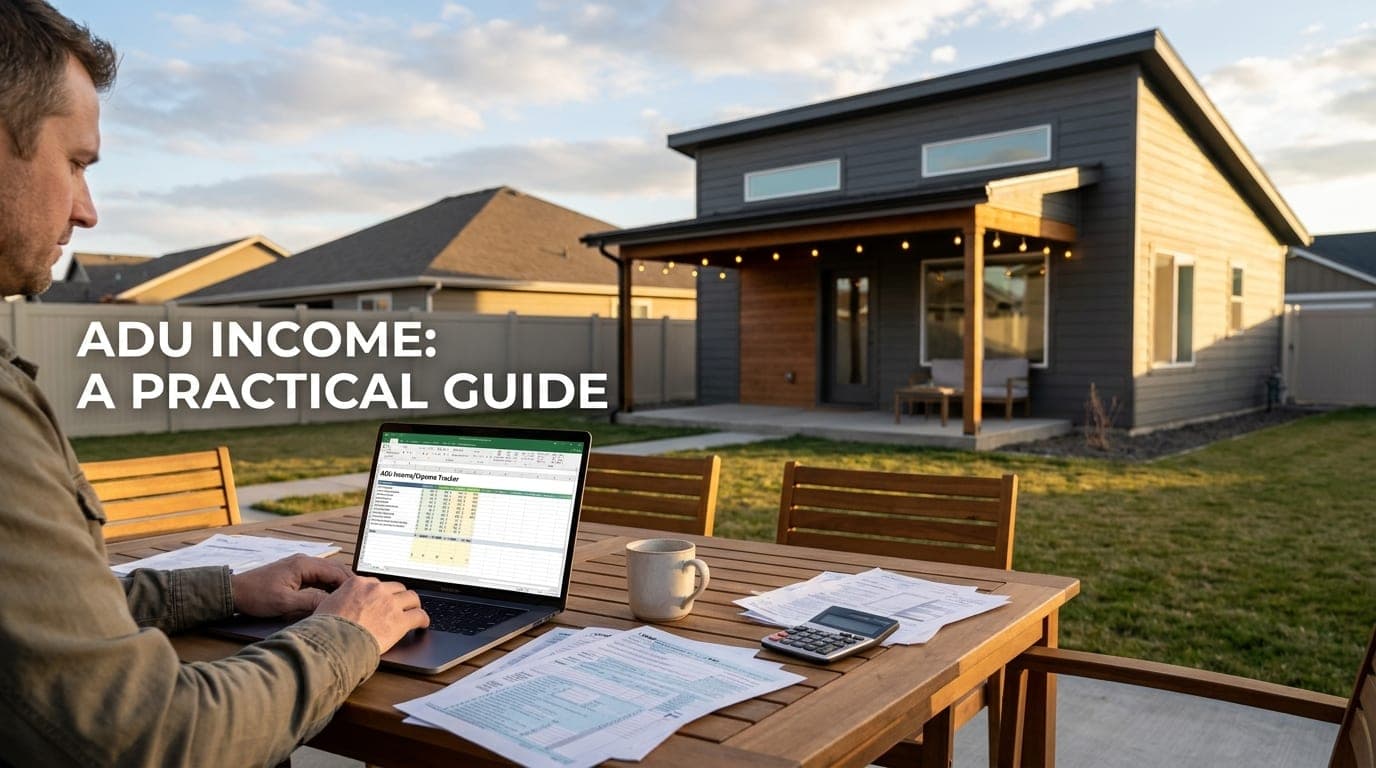
Keep records of everything: rent payments, repair receipts, utility bills, insurance premiums, and any professional fees. A simple spreadsheet updated monthly is enough for most single-ADU owners. If you are collecting $1,000 a month and spending $200 in legitimate operating costs, you are reporting $800 in net income, not $1,000.
One thing worth knowing: if your ADU is attached to your home and you live on the property, the IRS applies slightly different rules around shared expenses like a shared roof or HVAC system. You will need to allocate costs proportionally based on square footage. A local CPA familiar with rental properties can make this straightforward in about an hour of their time.
What Twin Falls ADU Owners Need to Know About Idaho Taxes
Idaho adds a state income tax layer on top of federal. Idaho has a flat 5.3 percent individual income tax rate as of 2025, which means your ADU net rental income will be taxed at that rate at the state level.
If you are a senior homeowner, it is also worth knowing that Idaho allows property tax reductions of $250 to $1,500 for qualifying seniors and disabled veterans on primary residences. That reduction applies to your primary home, not the ADU itself, but it does affect your overall property tax picture.
Adding an ADU will likely increase your property's assessed value, which means a modest property tax increase. Based on our project experience in Twin Falls County, a well-built 600 square foot ADU typically adds $40,000 to $70,000 in assessed value. At local mill rates, that translates to roughly $400 to $700 per year in additional property taxes. Compare that to $10,800 to $13,200 in annual gross rent from a unit leasing at $900 to $1,100 per month, and the math works convincingly in your favor. The additional property tax is also fully deductible as a rental expense on Schedule E.
Your Right to Rent Your ADU in Idaho
Idaho state law supports your ability to rent an ADU. SB 1354, signed into law in March 2026, prevents local governments and HOAs in cities with a population over 10,000 from banning ADUs. Twin Falls, with a population of approximately 50,000, is covered by this law. The legislation guarantees at least one ADU per lot and bars local rules that impose maximum size caps.
For homeowners in smaller Magic Valley towns like Kimberly, Filer, or Buhl that fall below the 10,000 threshold, the older HB 166 (2023) provides limited protection for internal ADUs (units inside a home or garage) against HOA bans, but local municipal zoning governs everything else. We cover how these laws differ by jurisdiction here.
Additionally, HB 583 (2026) limits how cities can regulate short-term rentals, preventing municipalities from imposing stricter rules on short-term rental properties than they have for other single-family dwellings. If you are considering listing your ADU on platforms like Airbnb or VRBO, this law is relevant, though you should still verify any local licensing requirements with your city.
Running the Real Numbers: A Twin Falls Example
Here is a realistic scenario. You build a 600 square foot detached ADU in Twin Falls for $120,000, financed with a construction loan. Your rent comes in at $1,000 per month, which is conservative for the current Magic Valley market.
Gross annual rent: $12,000
Less operating expenses (insurance, maintenance, utilities you cover): ($1,800)
Less depreciation (structure at $100,000 over 27.5 years): ($3,636)
Less mortgage interest on construction loan (estimated): ($5,500)
Net taxable rental income: approximately $1,064
On roughly $1,000 of net taxable income, your combined federal and state tax liability is modest, often under $300 for the year. Meanwhile, your actual cash flow after loan payments might be neutral to slightly positive depending on your loan terms, and you are building equity in a property that is appreciating in value.
That is a very different picture than "taxes will eat my rental income."
If you want to understand how ADU financing structures affect your overall numbers, or if you are concerned about hidden construction costs eating into your returns, those guides walk through the details.
What Happens When You Sell
When you sell a property with an ADU, two tax events are in play.
First, any depreciation you claimed over the years gets "recaptured" and taxed as ordinary income at the federal level, up to a maximum rate of 25 percent. This is not a surprise if you plan for it, but it catches some sellers off guard.
Second, your overall capital gain on the property sale is subject to both federal and Idaho state tax. Idaho taxes capital gains as ordinary income at the flat 5.3 percent rate. However, Idaho offers a valuable benefit: a 60 percent deduction on capital gains from qualifying Idaho property. Since your Twin Falls home with an ADU is Idaho real property, a substantial portion of your gain may qualify for this deduction, significantly reducing your state tax burden.
If the home was your primary residence for at least two of the last five years, a significant portion of your gain may also qualify for the federal home sale exclusion ($250,000 for single filers, $500,000 for married filing jointly).
Talk to a CPA before you sell. The interaction between depreciation recapture, the Idaho 60 percent deduction, and the federal home sale exclusion is specific to your situation, and planning ahead can save you meaningful money.
Ready to See What an ADU Pencils Out to for Your Property?
If you are considering an ADU in Twin Falls or the surrounding Magic Valley, the tax picture is more favorable than most homeowners expect. But the numbers are property-specific, and understanding how income, taxes, depreciation, and financing interact before you build is what separates a smart investment from a stressful one.
Twin Falls ADU Guys offers a free Readiness Call that takes 10 to 15 minutes. We will discuss your property, your goals, and how you plan to use the unit, then give you an honest picture of what the financial side looks like for your situation.
You can schedule your Readiness Call at twinfallsaduguys.com or call us directly at (208) 613-9830.
Frequently Asked Questions
Do I have to report ADU rental income if I am just renting to a family member?
Yes. The IRS requires reporting rental income regardless of who the tenant is. However, if you charge below fair market rent to a relative, the IRS may classify it as personal use rather than rental activity, which limits your ability to claim deductions. Charging fair market rent and documenting it properly protects your ability to deduct expenses.
Will building an ADU significantly raise my property taxes in Twin Falls?
It will raise them modestly. Based on our project experience, expect your assessed value to increase by $40,000 to $70,000 for a quality 600 square foot build, translating to roughly $400 to $700 per year in additional property taxes. That is a small fraction of typical rental income and is fully deductible as a rental expense on Schedule E.
Can I use ADU rental income to help qualify for a construction loan?
In many cases, yes. Fannie Mae and Freddie Mac guidelines allow documented ADU rental income to be considered during loan qualification. Working with a lender experienced in ADU financing makes a significant difference here, since not all loan officers know how to structure these applications.
What records should I keep as an ADU landlord?
Keep records of all rent payments received, maintenance and repair costs, utility bills you pay, insurance premiums, any professional fees (property manager, accountant), and your original construction cost broken down between land and structure. A simple monthly spreadsheet combined with a dedicated folder for receipts is usually enough for a single-ADU owner.
How does depreciation recapture work when I sell?
When you sell the property, the total depreciation you claimed over the years is "recaptured" and taxed as ordinary income at the federal level, up to a maximum rate of 25 percent. For example, if you claimed $36,000 in depreciation over ten years, that amount is added back to your taxable income in the year of sale. This is a known cost of claiming depreciation, and it is almost always worth it because the annual tax savings from depreciation far exceed the eventual recapture tax for most homeowners. Consult a CPA before selling to plan for this.
Does Idaho offer any special tax benefits for ADU owners?
Idaho does not have an ADU-specific tax incentive, but the state's flat 5.3 percent income tax rate is among the lowest in the country, and the 60 percent capital gains deduction on qualifying Idaho property is a significant benefit when you eventually sell. Combined with the federal deductions available through Schedule E, the overall tax environment in Idaho is favorable for rental property owners.
Twin Falls ADU Guys Team
Twin Falls ADU Guys