TL;DR: Yes. A permitted, well-built ADU typically increases a home's value by 15 to 35%, with detached units adding the most. The FHFA found that properties with ADUs appreciated at 9.3% annually compared to 7.7% for properties without, resulting in 22% more cumulative growth over a decade (California data). In Twin Falls, a $120,000 ADU on a $350,000 home could add roughly $90,000 to $110,000 in appraised value, plus generate $900 to $1,100 per month in rental income. The value added doesn't always equal the construction cost, but when you combine appreciation, rental income, tax benefits, and long-term equity, the investment math is strong. Unpermitted ADUs are the exception: they can lower your home's value and create deal-killing problems at closing.
It's the question behind every other question. Before you ask about costs, timelines, permits, or floor plans, you need to know: will this investment actually make my property worth more?
The short answer is yes, in most cases. But the amount of value an ADU adds depends on what you build, how you build it, and what your local market rewards. This guide breaks down the data, explains how appraisers actually value ADUs in 2026, and shows what the math looks like specifically for Twin Falls.
What the National Data Shows
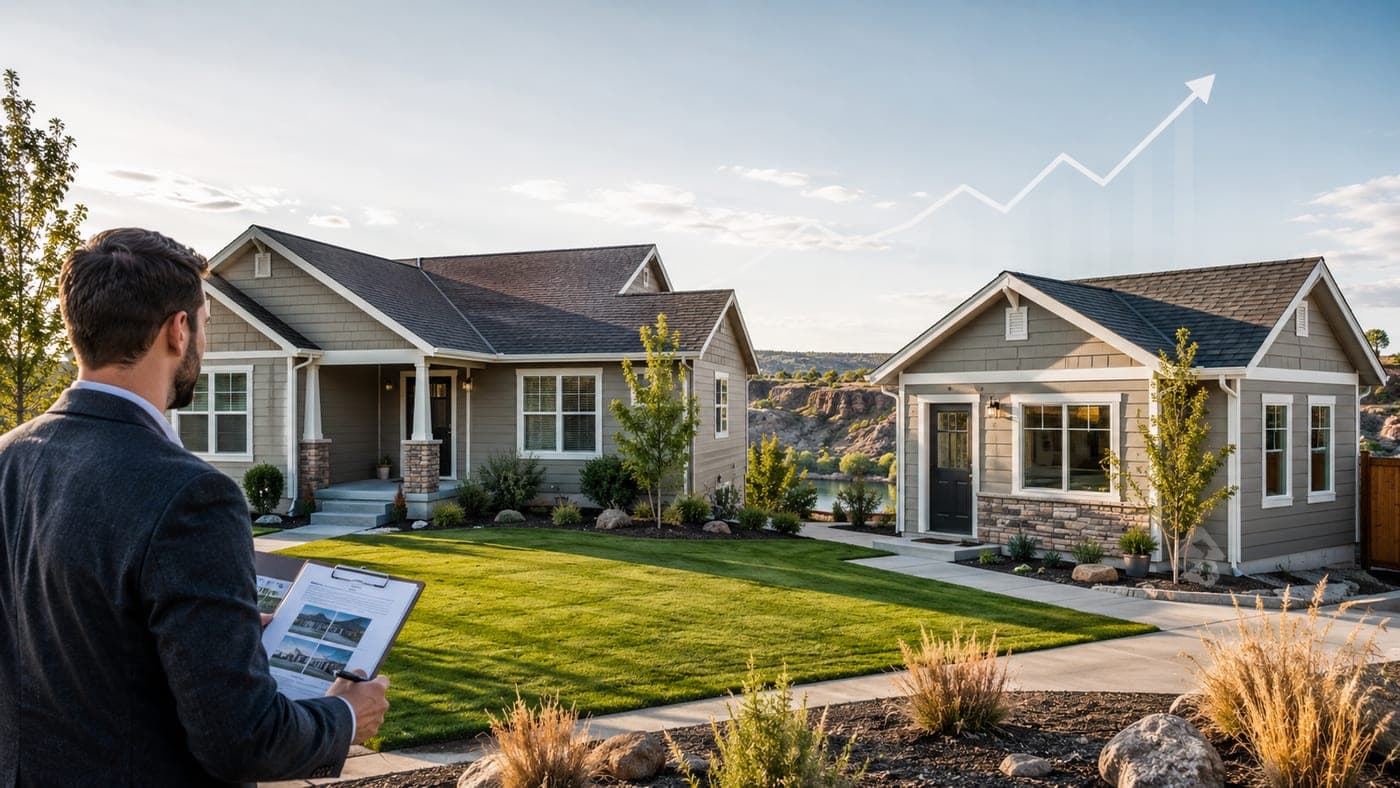
The most rigorous ADU valuation study to date comes from the Federal Housing Finance Agency (FHFA). Their analysis of Enterprise-backed mortgage appraisals from 2013 to 2023 found that properties with ADUs appreciated at an annualized rate of 9.34%, compared to 7.65% for properties without ADUs. Over a decade, that difference compounds to approximately 22% more cumulative growth.
A few important caveats about this data:
It's California-specific. The FHFA study covers the state with the most ADU activity and the highest housing costs. Idaho's market is different. Appreciation rates, buyer demand, and rental yields don't mirror California's.
It measures appreciation, not instant value increase. The 22% figure isn't a one-time bump. It's the cumulative effect of ADU properties growing faster in value over ten years. The immediate value increase from adding an ADU is a separate question (covered below).
The share of ADU appraisals is growing. The FHFA data shows the share of appraisals that include an ADU rose from 1.9% in 2013 to 2.9% in 2023, an increase of roughly 60%. More ADU data means appraisers have better comparable sales to work with, which makes ADU valuations more consistent and reliable.
How Much Value Does an ADU Actually Add?
There are three common ways to estimate the immediate value increase from an ADU. None is perfect, but together they give you a reasonable range.
Method 1: The 30% rule
Industry analysis suggests that a well-built ADU typically adds roughly 30% of the home's current value. For a Twin Falls home valued at $350,000, that's approximately $105,000 in added value.
This is a rough rule of thumb, not a guarantee. The actual percentage depends on ADU type, quality, and local market conditions.
Method 2: The 100x rent rule
A commonly used estimate in the appraisal community is that a newly constructed ADU adds approximately 100 times its monthly rental value to the property. At Twin Falls rental rates of $900 to $1,100 per month, that puts the value increase at $90,000 to $110,000.
This method directly ties the ADU's value to its income-producing potential, which is how many buyers evaluate rental properties.
Method 3: Per-square-foot comparison
Appraisers look at what comparable properties sell for per square foot and adjust for the ADU. However, ADU square footage doesn't appraise at the same per-square-foot value as the primary home. Industry data suggests ADU space is typically valued at about 30% of the home's per-square-foot rate.
For a Twin Falls home selling at $200 per square foot, a 600 sq ft ADU would add roughly $36,000 in square footage value (600 x $200 x 0.30). This method tends to produce the most conservative estimate because it doesn't fully account for the rental income the unit generates.
What the range looks like for Twin Falls
Estimation Method | Estimated Value Increase |
|---|---|
30% rule ($350,000 home) | ~$105,000 |
100x rent ($1,000/month) | ~$100,000 |
Per-sq-ft (conservative) | ~$36,000 to $55,000 |
Realistic range | $80,000 to $110,000 |
The realistic range for a well-built, permitted, 600 sq ft detached ADU in Twin Falls is approximately $80,000 to $110,000 in added property value. That's against a construction cost of $100,000 to $175,000, which means the immediate value increase may not fully cover the build cost. But this isn't the whole story.
The Math That Most Blogs Leave Out
Looking only at the immediate value increase versus construction cost misses the full picture. The real return on an ADU comes from three sources working together over time.
1. Property value increase (immediate)
$80,000 to $110,000 in added appraised value, as estimated above. This is real equity that increases your net worth and your borrowing power from day one.
2. Rental income (ongoing)
At $900 to $1,100 per month ($10,800 to $13,200 per year), rental income compounds year after year. Over five years, that's $54,000 to $66,000 in gross rental income. Over ten years, $108,000 to $132,000. Even after operating expenses (property taxes, insurance, maintenance), net rental income over a decade typically exceeds the original construction cost.
3. Appreciation premium (compounding)
If the FHFA's finding holds directionally (ADU properties appreciate faster than non-ADU properties), your home gains value at a higher rate every year simply because the ADU exists. On a $350,000 property, even a 1% annual appreciation premium adds $3,500 per year, compounding over time.
Combined 10-year return
Return Source | 10-Year Estimated Value |
|---|---|
Immediate property value increase | $80,000 to $110,000 |
Net rental income (after expenses) | $75,000 to $95,000 |
Appreciation premium (1% extra annually) | $35,000 to $45,000 |
Total estimated 10-year return | $190,000 to $250,000 |
Against a construction cost of | $100,000 to $175,000 |
Even at the conservative end, the 10-year return exceeds the construction cost. At the higher end, you're looking at roughly 140 to 250% return on your investment. This is why ADUs are consistently ranked among the strongest residential investments available.
What Drives ADU Value Up (and Down)
Not all ADUs add the same amount of value. Here's what makes the difference.
What increases value
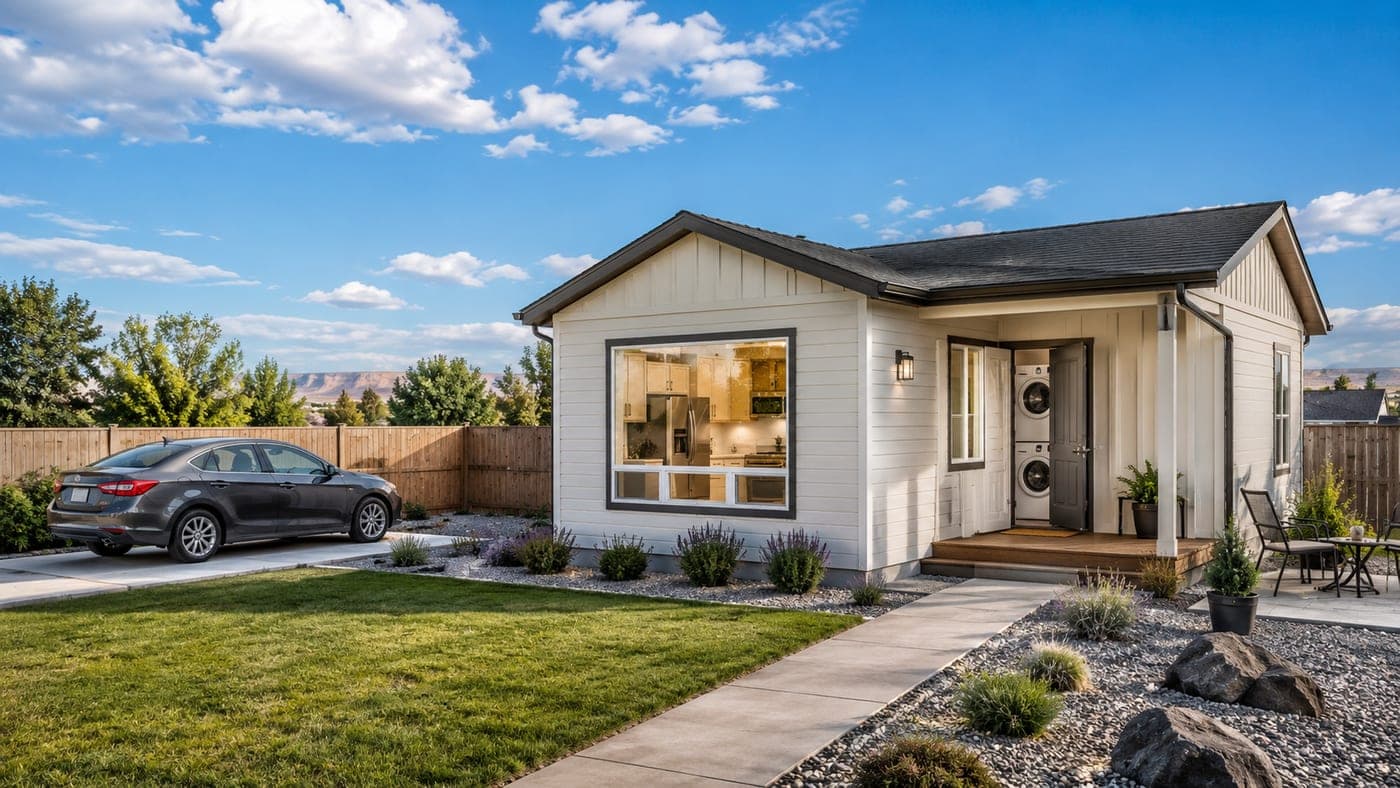
Detached units add the most. Detached ADUs consistently outperform attached ADUs and conversions in appraisals because they add net new livable square footage with maximum privacy and rental flexibility.
Permitted construction is non-negotiable. An unpermitted ADU isn't just a paperwork problem. It can lower your property's appraised value, create lending complications for buyers, trigger demolition disclosure requirements, and kill deals at closing. Permitted units are reflected in title records, included in appraisals, and financeable by conventional lenders.
Private entrance with clear separation. HomeLight research confirms that a separate entrance is the single most important amenity for boosting both rental income and resale value.
Full kitchen and bathroom. A unit with complete living facilities (full-size appliances, real counter space, full bathroom) appraises as a genuine dwelling unit, not a bonus room.
Quality construction that matches the primary home. The Twin Falls code requires ADUs to match the primary home's roof pitch, siding, and windows. Beyond code compliance, design consistency signals quality to buyers and appraisers.
What decreases or limits value
Unpermitted construction. An unpermitted ADU can actively reduce your home's value by creating disclosure obligations, lending complications, and buyer uncertainty.
Poor-quality finishes. Cheap materials, sloppy workmanship, and obvious cost-cutting signal risk to buyers and appraisers. Mid-range finishes done well outperform premium finishes done poorly.
Oversized units on small lots. An ADU that consumes all available yard space can actually reduce buyer appeal, especially for families. Proportionality matters.
Limited comparable sales. In markets like Twin Falls where ADU sales data is still limited, appraisers may be conservative in their valuations simply because they have fewer comps to support higher numbers. This is improving as ADU adoption grows.
How Appraisers Value ADUs in 2026
The appraisal landscape for ADUs has improved significantly. In 2023, FHFA added ADU-specific data fields to the Uniform Appraisal Dataset (UAD). The updated UAD 3.6, now being adopted across the industry, gives appraisers a structured way to document ADU characteristics including type, size, condition, and rental income.
Appraisers typically use two approaches:
Sales comparison approach. The appraiser finds recent sales of similar properties with ADUs and adjusts for differences in unit type, size, quality, and location. As more ADU properties sell in the Magic Valley, this approach becomes more reliable.
Income approach. The appraiser estimates the rental income the ADU can generate, subtracts operating expenses, and applies a market capitalization rate to determine value. This approach directly rewards units with strong rental potential.
In Twin Falls, where ADU comparable sales are still relatively limited, appraisers may lean more heavily on the income approach. A well-documented rental history (even six months of consistent payments) strengthens your appraisal.
Idaho's 2026 Laws Add a New Dimension
Two laws from the 2026 session affect how ADU value works in Idaho going forward.
SB 1354 (effective July 1, 2026) requires all Idaho cities over 10,000 to allow ADUs by right. This removes the regulatory uncertainty that previously made some buyers nervous about ADU properties. When buyers know the ADU is legally protected at the state level, not just tolerated at the local level, they're willing to pay more for it.
HB 800 creates a path for lot splits on properties with ADUs. This means an ADU could eventually be sold as a separate property, which fundamentally changes the investment math. Instead of only benefiting from the ADU through rental income and added property value, you could potentially sell the ADU and its lot independently. This optionality has value even if you never exercise it.
Frequently Asked Questions
Does an ADU always increase home value?
A permitted, well-built ADU with a full kitchen, private entrance, and quality construction almost always increases value. An unpermitted, poorly built, or oversized ADU can have the opposite effect. Quality and compliance are the two variables that matter most.
How soon after building can I see the value increase?
The value increase is immediate upon completion and certificate of occupancy. Your next property appraisal (whether for refinancing, a HELOC, or a sale) should reflect the ADU's contributory value. Having a documented rental history strengthens the appraisal.
Will the value added equal what I spent to build it?
Not always immediately. Industry data suggests the immediate appraised value increase covers roughly 60 to 90% of construction cost in moderate markets. However, when you add ongoing rental income and the appreciation premium, the total return exceeds construction cost within 3 to 5 years for most Twin Falls projects.
Does the type of ADU matter for value?
Yes. Detached ADUs add the most value because they represent net new livable square footage with maximum privacy. Garage conversions add less because they repurpose existing space rather than creating new space. Attached additions fall in between.
How does an unpermitted ADU affect my home's value?
Negatively. An unpermitted ADU creates disclosure obligations at sale, lending complications for buyers (conventional lenders may refuse to finance), and potential demolition requirements from the city. If you have an unpermitted unit, the best path is to retroactively permit it before listing your property.
Can I sell my ADU separately from my home?
Under Idaho's new HB 800 (2026), a limited lot-split path now exists for properties with an existing or approved ADU. This could enable separate ownership or financing of the ADU portion. The details are still being implemented, but the legal framework now exists.
An ADU is one of the strongest property investments available to Twin Falls homeowners, but the return depends on building the right thing on the right lot with the right permits. If you want to know what an ADU could do for your property's value, reach out to Twin Falls ADU Guys for a feasibility check. We'll evaluate your lot, project realistic costs and rental income, and help you understand the full financial picture before you commit.
Twin Falls ADU Guys Team
Twin Falls ADU Guys