How Long Does It Take to Build an ADU in Twin Falls?
TL;DR: A detached ADU in Twin Falls takes 7 to 12 months from your first conversation to a certificate of occupancy. A garage conversion takes 5 to 8 months. The timeline breaks into four phases: feasibility (1 to 2 weeks), design (4 to 10 weeks), permitting (2 to 8 weeks), and construction (3 to 8 months). The biggest variables are permit review timing (spring is faster, summer is slower), site conditions, and how quickly you make design decisions. Starting in late winter gives you the best shot at finishing before the holidays. This guide walks through every phase with realistic Twin Falls durations so you can plan with confidence.
"How long will it take?" is the second question every homeowner asks, right after "how much will it cost?" And just like cost, the honest answer is "it depends," but that's not helpful when you're trying to plan your life around a construction project.
So let's make it specific. This guide breaks the ADU timeline into four phases, gives you realistic durations for each one in the Twin Falls market, and shows you what actually causes delays so you can avoid them.
The Short Answer
ADU Type | Total Timeline (First Call to Move-In) |
|---|---|
Detached new build (500 to 800 sq ft) | 7 to 12 months |
Garage conversion (400 to 600 sq ft) | 5 to 8 months |
Attached addition (400 to 700 sq ft) | 6 to 10 months |
Prefab/modular (installed) | 5 to 9 months |
These ranges assume a straightforward lot, a decisive homeowner, and a builder who knows the Twin Falls market. Complex lots, design changes mid-process, or summer permitting can push timelines toward the longer end.
Phase 1: Feasibility (1 to 2 Weeks)
This is where every project should start. A feasibility check evaluates your lot's zoning, setbacks, lot coverage, utility access, and site conditions to determine what you can build and what it will cost.
What happens: Your builder pulls your parcel data, verifies your zoning classification against the Twin Falls Uniform Development Code, visits your property, measures distances, checks utility connection points, and delivers a written report with a cost projection and recommended next steps.
Duration: 1 to 2 weeks from initial contact to written report.
What can delay this phase: Nothing, if you're working with a builder who has an established process. This is the fastest phase and should never be the bottleneck.
What you're deciding: Go or no-go. If feasibility confirms your property can support an ADU within your budget, you move to design. If it doesn't, you've spent $250 to $750 and saved yourself thousands in wasted design fees.
Phase 2: Design (4 to 10 Weeks)
Design is where your ADU goes from concept to construction-ready drawings. The duration depends on whether you're using a custom design or working from a pre-existing plan, and how quickly you make decisions.
What happens:
Task | Duration | Notes |
|---|---|---|
Schematic design (floor plan, layout) | 2 to 4 weeks | Faster if working from an existing plan template |
Design development (materials, finishes, systems) | 1 to 3 weeks | Your decision speed is the biggest variable |
Construction documents (permit-ready drawings) | 2 to 4 weeks | Includes structural engineering and energy calcs |
Total design phase | 4 to 10 weeks |
What can delay this phase:
Indecision. Every week you spend debating countertop materials or window placement is a week the project isn't moving forward. The design phase is the one phase where the homeowner controls the timeline most directly.
Incomplete feasibility data. If the builder didn't do a thorough feasibility check, the designer may discover setback issues or utility constraints mid-design, which means starting over on portions of the layout.
Custom vs. template. A fully custom design takes longer than adapting a pre-existing floor plan. If timeline matters more than uniqueness, starting from one of the six floor plans on the Twin Falls ADU Guys website can shave 2 to 4 weeks off this phase.
How to keep this phase on track: Make finish selections (flooring, cabinets, countertops, fixtures) during design, not during construction. Every decision deferred to the construction phase becomes a delay later.
Phase 3: Permitting (2 to 8 Weeks)
Permitting is the phase homeowners have the least control over and the most anxiety about. The good news: Twin Falls is not Los Angeles. Permit review timelines here are shorter and more predictable than in major metro areas.
What happens:
Your builder or designer submits the complete permit application package to the Twin Falls Building Department, including architectural drawings, structural engineering, energy code compliance documentation, and site plans. The city reviews the package for zoning compliance, building code compliance, and completeness.
Twin Falls review timelines:
Submission Timing | Typical Review Duration | Notes |
|---|---|---|
Spring (March to May) | 2 to 4 weeks | Lower volume, faster reviews |
Summer (June to August) | 4 to 8 weeks | Peak submission volume, longer queues |
Fall/Winter (September to February) | 3 to 5 weeks | Moderate volume |
What can delay this phase:
Incomplete submissions. If your plans are missing details (structural calculations, energy compliance, utility documentation), the city sends a correction notice and the clock resets. The most common reason for permit delays isn't city bureaucracy. It's incomplete applications.
Plan review corrections. Even well-prepared submissions sometimes receive correction requests. Each correction cycle adds 1 to 3 weeks. A builder who has submitted ADU permits in Twin Falls before knows what reviewers look for and designs to pass on the first review.
Concurrent utility coordination. While the city reviews your building permit, you also need to coordinate with utility providers (Idaho Power, city water and sewer) for connection approvals. This runs on a parallel track and can take 4 to 8 weeks independently. A good builder starts this process as soon as the permit application is submitted, not after it's approved.
What SB 1354 changes: Effective July 1, 2026, ADU projects that meet established standards must be approved administratively, as a matter of right. No discretionary review. This should reduce correction cycles and eliminate the uncertainty of subjective design review for most standard ADU projects.
Phase 4: Construction (3 to 8 Months)
This is the phase everyone pictures when they think about building an ADU. It's also the most variable, because weather, subcontractor scheduling, inspections, and material deliveries all affect the timeline.
Detached new build: 5 to 8 months of construction
Stage | Duration | What's Happening |
|---|---|---|
Site prep and excavation | 1 to 2 weeks | Clearing, grading, utility trenching |
Foundation | 2 to 3 weeks | Formwork, pour, curing time |
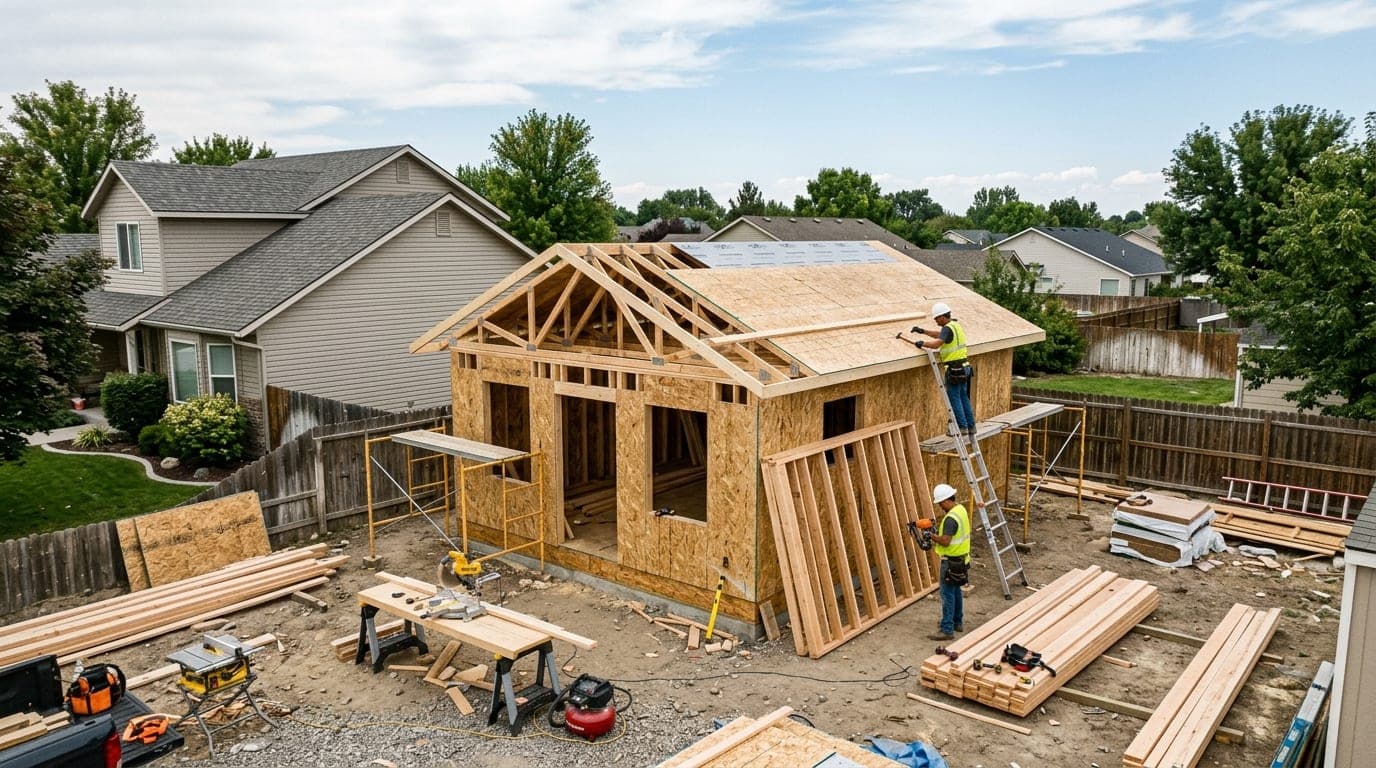
Framing | 2 to 3 weeks | Walls, roof structure, sheathing |
Roofing and exterior | 1 to 2 weeks | Shingles/metal, siding, windows, doors |
Rough mechanical | 2 to 3 weeks | Electrical, plumbing, HVAC rough-in |
Insulation and drywall | 1 to 2 weeks | Insulation, hanging, taping, finishing |
Interior finishes | 3 to 5 weeks | Cabinets, countertops, flooring, paint, fixtures |
Final utilities and connections | 1 to 2 weeks | Service connections, meter setup |
Inspections and punch list | 1 to 2 weeks | Final inspections, corrections, CO issuance |
Total | 5 to 8 months |
Garage conversion: 3 to 5 months of construction
Garage conversions skip foundation, framing, and roofing, which eliminates the three most time-consuming stages. The work focuses on interior transformation: insulation, electrical upgrades, plumbing, HVAC, drywall, and finishes.
Stage | Duration | What's Happening |
|---|---|---|
Structural modifications | 1 to 2 weeks | Removing garage door, adding windows, reinforcing as needed |
Rough mechanical | 2 to 3 weeks | Electrical (often includes panel upgrade), plumbing, HVAC |
Insulation and drywall | 1 to 2 weeks | Walls and ceiling |
Interior finishes | 3 to 4 weeks | Kitchen, bathroom, flooring, paint, fixtures |
Final connections and inspections | 1 to 2 weeks | Utility hookups, final inspections, CO |
Total | 3 to 5 months |
Prefab/modular: 4 to 7 months (including manufacturing lead time)
Prefab ADUs split the timeline into two parallel tracks: factory manufacturing happens while your site is being prepared.
Stage | Duration | What's Happening |
|---|---|---|
Order and manufacturing | 8 to 16 weeks | Unit built off-site |
Site prep and foundation (concurrent) | 3 to 6 weeks | Runs parallel with manufacturing |
Delivery and set | 1 to 2 days | Crane placement on prepared foundation |
Utility connections and finishing | 2 to 4 weeks | Hookups, skirting, landscaping, inspections |
Total | 4 to 7 months |
The main advantage of prefab is predictability, not necessarily speed. Factory construction eliminates weather delays and most subcontractor scheduling issues.
What Actually Causes Delays
Understanding the common delay sources helps you avoid them.
Summer permitting backlog. Submitting your permit application in June or July puts you at the back of the longest queue. Applications submitted in March or April move through review noticeably faster.
Design changes during construction. Every change order during the build requires revised drawings, re-approval, potential material reordering, and schedule adjustment. One change can add 1 to 3 weeks. Multiple changes compound. Make your decisions during the design phase, not from the job site.
Weather. Twin Falls winters bring frozen ground, snow, and shortened daylight. Foundation work before mid-March is risky. Exterior work after mid-November is slow. The ideal construction window runs April through October. Our spring timing guide covers why starting in late winter gives you the best timeline.
Subcontractor scheduling. Electricians, plumbers, and HVAC technicians work across multiple job sites. If your builder doesn't have established relationships with reliable subs, gaps between trades can add weeks of dead time.
Material lead times. Windows, cabinets, and specialty finishes can take 4 to 8 weeks to arrive after ordering. A good builder orders long-lead items during the design phase so they're on-site when needed, not when the crew is standing idle waiting for delivery.
Inspection scheduling. Each stage of construction requires city inspection before the next stage begins. If the building department is backed up, inspection wait times can add days or weeks between stages. A builder who knows the inspection schedule and plans around it keeps the project moving.
A Realistic Month-by-Month Timeline
Here's what a well-planned 600 sq ft detached ADU project looks like in Twin Falls, starting in February.
Month | Phase | What's Happening |
|---|---|---|
February | Feasibility | Site visit, lot assessment, cost projection, go/no-go decision |
March | Design | Floor plan, finish selections, construction documents, engineering |
April | Permitting | Permit application submitted, utility coordination begins |
May | Permit + site prep | Permit approved, site clearing, excavation begins |
June | Foundation + framing | Foundation poured and cured, framing starts |
July | Framing + roofing | Framing complete, roof on, exterior sheathing |
August | Rough mechanical | Electrical, plumbing, HVAC rough-in, insulation |
September | Finishes | Drywall, cabinets, countertops, flooring, paint |
October | Final | Utility connections, final inspections, certificate of occupancy |
November | Move-in ready | Tenant moves in or unit listed for rent |
That same project, started in June instead of February, realistically finishes in February or March of the following year. The delay comes from summer permit backlogs, lost construction days to winter weather, and the compressed daylight hours of December and January.
At Magic Valley rental rates of $900 to $1,100 per month, a 4-month delay in your certificate of occupancy represents $3,600 to $4,400 in lost rental income.
Frequently Asked Questions
What's the fastest I can get an ADU built in Twin Falls?
Under ideal conditions (garage conversion, straightforward lot, spring permit submission, decisive homeowner), 5 months from first call to certificate of occupancy is achievable. For a detached new build, 7 months is an aggressive but realistic best case.
Can I speed up the permit process?
The single most effective thing you can do is submit a complete, well-prepared permit application the first time. Correction cycles are what stretch permitting from 3 weeks to 8 weeks. Working with a builder who has submitted ADU permits in Twin Falls before dramatically reduces correction risk.
Does winter construction add time?
Yes. Foundation work before mid-March is risky due to frost. Exterior work after mid-November is slower. Framing and interior work can proceed through winter, but shorter days and weather interruptions add roughly 15 to 25% to the construction timeline for projects that span December through February.
How long does the inspection process take at the end?
Final inspections (building, electrical, plumbing, mechanical, fire) typically take 1 to 2 weeks to schedule and complete if there are no corrections needed. If corrections are required, add 1 to 2 weeks per correction cycle. A builder who stays ahead of code requirements minimizes this risk.
Is prefab faster than site-built?
Not always. Prefab manufacturing takes 8 to 16 weeks, and site prep runs concurrently. Total timeline is often 4 to 7 months, which overlaps with the garage conversion range and is only slightly faster than a well-managed site-built project. Prefab's real advantage is predictability (no weather delays during manufacturing), not necessarily speed.
What's the longest an ADU project can realistically take?
Projects with complex lots, design changes during construction, summer permit submissions, and winter construction can stretch to 14 to 16 months. These are outliers, but they happen. The best way to prevent it is a thorough feasibility check, decisive design phase, and spring permit submission.
If you want a realistic timeline for your specific property in Twin Falls, reach out to Twin Falls ADU Guys. A feasibility check gives you the data to plan not just what you'll build, but when you'll build it, and when you can expect the first tenant to move in or the first family dinner in the new space.
Twin Falls ADU Guys Team
Twin Falls ADU Guys