What Happens During an ADU Feasibility Check in Twin Falls?
TL;DR: A feasibility check is a paid, on-site assessment of your property that tells you exactly what you can build, what it will cost, and what obstacles stand in the way before you spend a dollar on design. At Twin Falls ADU Guys, this runs $250 to $750 and gets credited toward your project if you move forward. The check covers zoning verification, lot measurements, utility assessment, site conditions, cost projections, and financing guidance. It typically takes one to two weeks and replaces guesswork with data. Most ADU projects that stall or blow their budget do so because this step was skipped. Here's exactly what we look at and why each piece matters.
The most expensive mistake in ADU construction is not a bad contractor or a cost overrun. It's spending $5,000 to $8,000 on architectural plans for a unit that your lot can't support, your zoning won't allow, or your utilities can't reach affordably. That mistake happens when homeowners skip straight to design because they're excited about a floor plan they found online.
A feasibility check is the step that prevents that. It's not glamorous. Nobody posts their feasibility report on Instagram. But it's the single most cost-effective thing you can do at the start of an ADU project, and it's where every Twin Falls ADU Guys project begins.
Here's exactly what happens during one, step by step.
Step 1: Zoning and Code Verification
Every lot in Twin Falls has a zoning classification, and that classification determines what you're allowed to build. We don't guess at this. We pull your actual parcel data and verify it against the Twin Falls Uniform Development Code.
What we're checking:
Is an ADU permitted on your lot? Not every zoning district allows them. We confirm your classification (R-1, R-2, etc.) and whether accessory dwelling units are a permitted use.
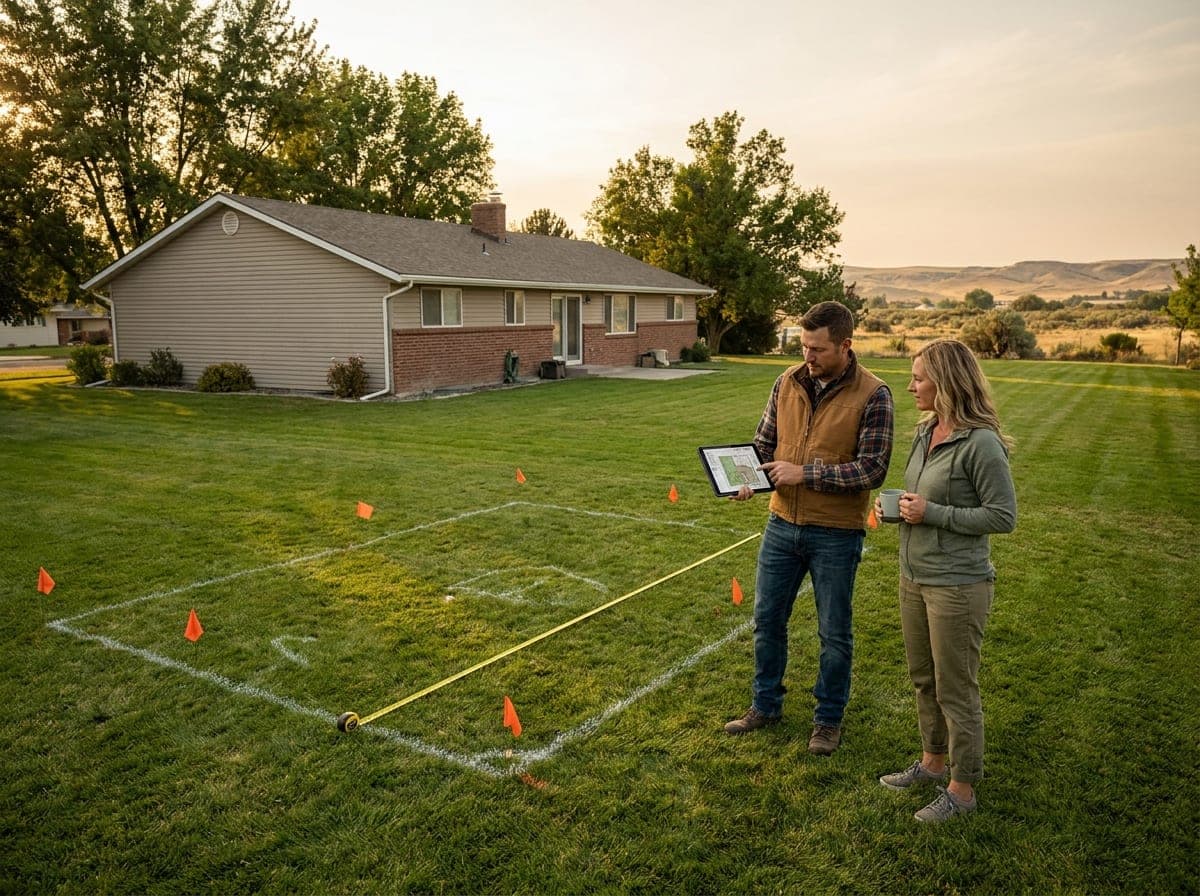
What are your setbacks? The Twin Falls code requires ADU setbacks to follow the property line setbacks for the principal building. These vary by zoning district and can differ between front, side, and rear property lines. We measure the actual distances on your lot, not just what the plat map says, because fences, sheds, and landscaping features don't always sit where the property line is.
What's your size cap? ADUs in Twin Falls cannot exceed 45% of the living space of the principal residence. For a 1,400 sq ft home, that means a maximum ADU of 630 sq ft. For a 1,800 sq ft home, the cap is 810 sq ft. This single number often determines whether your dream floor plan is viable or needs to be scaled down.
What's your lot coverage? Total lot coverage (all structures combined) is capped in most residential zones at 40 to 50% of the lot area. If you already have a house, a garage, and a large shed, you may not have enough coverage remaining for a detached ADU. We calculate exactly how much buildable area remains.
Design matching requirements. The code requires any new ADU construction to match the existing roof pitch, siding, and windows of your primary home. We note your current exterior materials so the design phase starts with these constraints already in hand.
This step alone has saved homeowners thousands of dollars by catching deal-breakers before a single drawing is commissioned.
Step 2: Physical Site Assessment
Satellite images and plat maps tell part of the story. Walking the property tells the rest.
During the on-site visit, we're looking at:
Topography and drainage. Is the buildable area flat, sloped, or graded in a way that requires additional foundation work? Does water pool anywhere after rain? Drainage issues that aren't visible from a satellite image can add significant cost to excavation and foundation work.
Access. Can construction equipment reach the build site? If the only path to the backyard is through a narrow gate, that affects how materials get delivered and what kind of equipment can be used. For homeowners considering a pre-fab unit, delivery access is even more critical because the module needs a clear path from the street to the pad.
Existing structures. We assess the condition of any existing garage, shed, or outbuilding that might be converted or that might need to be removed. For garage conversions, we check slab condition, ceiling height (most codes require a minimum of 7.5 feet for habitable space), wall integrity, and whether the roof structure can support the added loads of insulation and drywall.
Parking. The Twin Falls code requires one additional parking space for the ADU. We identify where that space can go and whether it requires any site work.
Trees and landscaping. Mature trees near the build area may have root systems that complicate foundation work or may be protected under local ordinances. We flag these early rather than discovering them during excavation.
Step 3: Utility Assessment
This is the step that produces the most surprises, and the most savings, for homeowners who do it early.
The Twin Falls ADU code specifies that ADUs must receive water, sewer, and sanitation from the primary dwelling, and that separate service lines and meters are not allowed. That simplifies the utility picture compared to markets like California, but it also means your existing services need enough capacity to support a second dwelling.
What we evaluate:
Electrical panel capacity. Does your current panel have enough capacity to support an ADU, or will it need an upgrade? Panel upgrades can cost several thousand dollars and need to be factored into your budget from day one.
Water and sewer connection points. Where are your existing lines, and how far is the run from the connection point to the proposed ADU location? Every additional foot of trenching adds cost. Sewer lines also need proper fall (downhill slope) to function without a pump, so the relative elevation of your connection point and your ADU pad matters.
Gas line access. If the ADU will have gas appliances or heating, we check whether your existing gas service can support the additional load and where the connection point is.
Electrical service distance. The run from your main panel to the ADU affects both cost and the gauge of wire required. A 50-foot run is a very different expense than a 150-foot run.
SnapADU's research on sitework and utility costs confirms what we see locally: two homeowners building the exact same ADU plan can end up with invoices that differ by tens of thousands of dollars based solely on differences in utility proximity and site conditions. The feasibility check is what catches that variance before it becomes a budget surprise.
Step 4: Cost Projection
Once we know what your lot allows, what the site conditions are, and what the utility picture looks like, we build a preliminary cost projection.
This is not a construction bid. It's a planning-level estimate that gives you a realistic range for your total project cost, including the line items that most early estimates leave out:
Hard costs: Foundation, framing, roofing, mechanical, electrical, plumbing, finishes.
Soft costs: Architectural plans, engineering, permit fees, plan review fees.
Site costs: Grading, excavation, utility trenching, connection fees.
Regulatory costs: Impact fees, inspection fees. According to NAHB's most recent analysis, regulations account for roughly 23.8% of the price of a new home, and the 2024 data shows that site work costs alone (including permits, impact fees, and utility fees) averaged $32,719 nationally. Those numbers scale down for an ADU, but the regulatory share stays roughly proportional.
Contingency. We include a contingency buffer because no project goes exactly as planned. Having this in your budget from the start means surprises don't derail the project.
The cost projection gives you a number you can take to a lender, compare against your equity position, and use to make an informed go/no-go decision.
Step 5: Financing Guidance
A feasibility report without a financing path is an interesting document that sits in a drawer. We walk through the financing options that fit your situation so the project has a way to actually move forward.
The most common options for Twin Falls ADU projects:
Home equity line of credit (HELOC). Works well if you have sufficient equity in your primary home and want flexible draw access. Rates are variable.
Construction loan. Releases funds in stages tied to project milestones. Higher rates than a standard mortgage, but structured specifically for ground-up construction.
Construction-to-permanent loan. Converts to a standard mortgage after construction is complete. Avoids the cost and complexity of refinancing after the build.
Cash-out refinance. Replaces your existing mortgage with a new, larger one and gives you the difference as cash for construction.
Each option has different qualification requirements, and some depend on your projected rental income. A feasibility report showing that your lot supports a 600 sq ft unit with projected rental income of $900 to $1,100 per month gives your lender something concrete to underwrite. Walking into a lender with a floor plan and no feasibility data gives them nothing to work with.
Step 6: The Deliverable
At the end of the process, you receive a written feasibility report that covers:
Your zoning classification and what it allows. Your lot measurements, setbacks, and remaining buildable area. The maximum ADU size your property can support. Utility connection points and estimated run distances. Site conditions that affect cost (grading, drainage, access, soil). A preliminary cost projection with a realistic range. Financing options matched to your situation. A recommended next step (custom design, pre-approved plan, garage conversion, or in some cases, a recommendation not to build).
That last point matters. Not every property is a good fit for an ADU, and the feasibility check is the honest moment where we tell you that. A "no" at this stage saves you from a much more expensive "no" three months and several thousand dollars later.
Why It's Worth $250 to $750
The fee range reflects the complexity of your property. A straightforward, flat lot in an R-2 zone with clear utility access is closer to $250. A lot with slope, drainage questions, tight setbacks, or a potential garage conversion that needs structural evaluation is closer to $750.
The fee gets credited toward your project if you move forward with Twin Falls ADU Guys. So if you build, the feasibility check is effectively free. If you don't build, you still walk away with a document that tells you exactly what your property can and can't do, which has value whether you revisit the project in a year or use it as a selling point when listing your home.
Compare that to the alternative: spending $4,000 to $8,000 on architectural plans only to discover during plan review that your setbacks are wrong, your lot coverage is maxed out, or your utility run makes the project financially impractical. That's the scenario the feasibility check exists to prevent.
Frequently Asked Questions
How long does the feasibility check take?
Most checks take one to two weeks from initial site visit to written report delivery. We're pulling zoning data, reviewing utility access, measuring the property, and running preliminary cost numbers. The timeline reflects actual research, not a quick glance at your address on Google Maps.
What do I need to prepare before the visit?
Not much. If you have a copy of your property survey, that helps. If you have a rough idea of what you want to build (detached vs. conversion, rental vs. family use), that helps us tailor the assessment. But you don't need drawings, financing approval, or a firm plan. Figuring all of that out is the point of the feasibility check.
Can the feasibility check tell me whether to do a garage conversion or a detached build?
Yes. That comparison is one of the most common outcomes. We evaluate both options against your lot size, existing structures, budget, and goals, and lay out the tradeoffs with real numbers. Our garage conversion vs. detached ADU comparison covers the general tradeoffs, but the feasibility check applies them to your specific property.
What if the check reveals my property isn't a good fit?
Then you've just saved yourself thousands of dollars and months of wasted time. A "no" at the feasibility stage is the cheapest possible outcome compared to discovering the same issue during plan review, permitting, or construction. Some properties genuinely aren't suited for an ADU due to lot coverage limits, utility constraints, or zoning restrictions. Finding that out early is the entire point.
Is the fee refundable if I don't move forward?
The fee is not refundable, but it is credited toward your project if you build with Twin Falls ADU Guys. Either way, you keep the written feasibility report and the data in it.
Can I use the feasibility report with a different builder?
Yes. The report is yours. If you decide to work with another contractor, the zoning data, lot measurements, and utility assessment are still valid and useful. We'd rather you build with the right information than build with us on bad data.
If you're considering an ADU in Twin Falls and want to know exactly what your property can support before you invest in design, reach out to Twin Falls ADU Guys. The feasibility check is where every successful project starts, because a build based on real data is a build that actually gets finished.
Twin Falls ADU Guys Team
Twin Falls ADU Guys