TL;DR:
The five most common issues that stop Twin Falls ADU projects are setback violations (especially on corner lots), utility connection costs that blow the budget, easements you did not know existed, HOA covenants that restrict secondary structures, and financing confusion that stalls the project before it starts. A feasibility check catches all five before you spend money on design or permits. Most are fixable once you know about them. Some are not, and knowing that early saves you thousands.
Why a Feasibility Check Matters More Than Most People Think
A lot of homeowners skip the feasibility step because it feels like extra time and money before the "real" work begins. But skipping it is like buying plane tickets before you check whether your passport is expired.
Research backs this up. A Northeastern University study of ADU implementation barriers found that 45 percent of potential ADU builders cited complex approval processes as their primary obstacle. In some communities, homeowners must navigate 18 separate fee-charging entities with different requirements just to get a single unit approved. Twin Falls is not that extreme, but it has its own set of layers that catch people off guard.
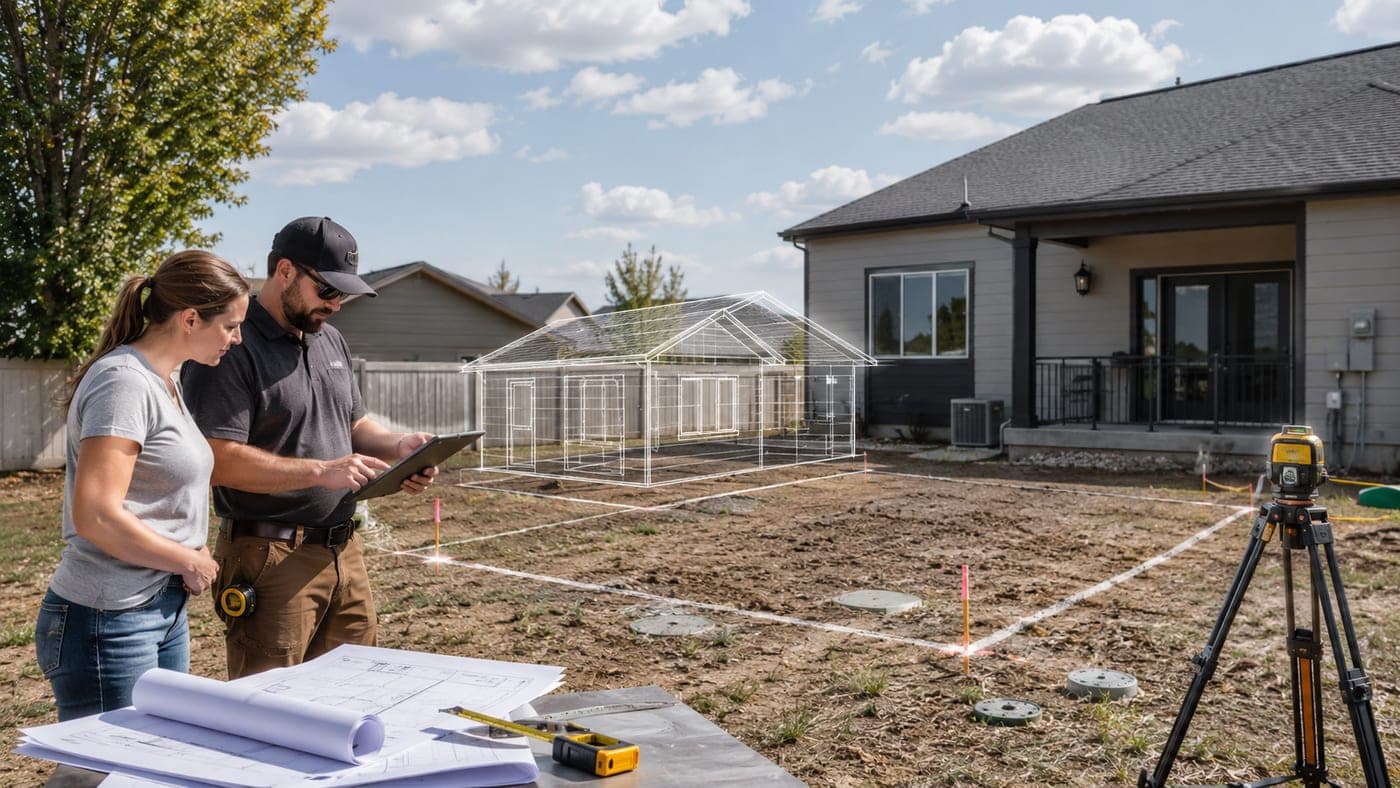
A good feasibility check maps all of that out upfront. It answers the question: can I actually build what I am imagining, on this specific lot, in this specific city?
Deal-Breaker 1: Your Lot Does Not Meet Setback Requirements
Zoning rules in Twin Falls specify how far your ADU must sit from property lines, existing structures, and easements. Many homeowners are surprised to discover that their yard looks plenty big visually but does not have a buildable footprint once setbacks are subtracted.
The most common version of this: a homeowner with a corner lot assumes they have more flexibility because of the extra space. In practice, corner lots often carry stricter side setback requirements because two sides face public streets. What looked like 800 square feet of usable backyard can shrink to 400 once the rules are applied.
This is the number one issue we catch during feasibility reviews. In some cases, a different ADU footprint, a different placement on the lot, or a prefab unit with a smaller envelope can work around the constraint. In others, the lot simply will not support what the homeowner envisioned.
The fix starts with pulling your parcel information from the Twin Falls County GIS system, confirming your zoning designation, and calling the Twin Falls Planning and Zoning office at (208) 735-7267 to ask about your specific setback requirements. If you are working with a smaller-than-average parcel, we cover strategies for small-lot ADU construction here.
Deal-Breaker 2: Easements and Encumbrances You Did Not Know Existed
This is the deal-breaker that no other ADU blog talks about, and it is one of the most frustrating because it is completely invisible from the surface.
Your property might have utility easements, drainage easements, or access easements recorded against it that you have not thought about since the day you closed. These easements can run right through the middle of where you planned to build.
A drainage easement along the back of a lot is the most common surprise. The homeowner sees a flat, open area that looks perfect for a detached ADU. What they do not see is that the city or an irrigation district holds rights to that strip of land, and you cannot permanently build on it under any circumstances. Building there anyway means being forced to tear it down.
Access easements are another hidden problem. If your neighbor has a recorded right to cross a portion of your lot to reach their property, you cannot block that access with a structure.
Checking easements requires pulling your plat map and title documents from the Twin Falls County Recorder's Office. It is not glamorous work, but it has saved more than a few homeowners from building in the wrong place. A thorough feasibility review always includes this step.
Deal-Breaker 3: Utility Connections Are Too Far or Too Costly
Water, sewer, and electrical connections for a new ADU often cost more than homeowners expect. If your main electrical panel is near capacity or your sewer lateral runs across the wrong side of the property, the cost to extend service to a backyard unit can add tens of thousands of dollars to your budget.
We have seen projects where the ADU itself was budgeted at $120,000, but the utility work alone came in at $30,000 once we assessed the site. That is not necessarily a reason to walk away, but it absolutely changes the financial math and the timeline.
The Mercatus Center at George Mason University noted in their 2025 ADU policy review that policies affecting the cost of providing infrastructure and utilities to serve ADUs may make them infeasible for many homeowners to build. In Portland, Oregon, impact fee waivers for ADUs led to major increases in permitting precisely because those utility costs were reduced.
During a feasibility check, we assess your current panel capacity, the location of your water and sewer connections, and what it would realistically cost to extend service. We cover the full breakdown of ADU utility costs in Twin Falls here, including metering options and the gas-versus-all-electric decision.
Deal-Breaker 4: HOA Rules or CC&Rs That Restrict ADUs
Idaho state law has made meaningful progress in supporting ADU development, but private covenants recorded by an HOA or a prior developer can still create roadblocks.
For Twin Falls homeowners, SB 1354 (signed March 2026) prevents cities over 10,000 from banning ADUs and guarantees at least one ADU per lot. That covers Twin Falls. The older HB 166 (2023) prevents HOAs from strictly prohibiting internal ADUs (units inside a home or garage) on owner-occupied homesteads.
However, older CC&Rs recorded before July 1, 2023 may still restrict detached ADUs, impose design standards that dramatically limit your options, or require HOA approval processes that take months. HB 166 did not retroactively void those pre-existing covenants.
We always recommend reviewing your CC&Rs before doing anything else. If you are not sure where to find them, your county recorder's office or your original title documents are good starting points. Not every HOA rule is enforceable in the same way, and some older CC&Rs have legal ambiguities worth exploring with an attorney.
Deal-Breaker 5: The Financial Math Does Not Work Without the Right Structure
Sometimes a lot is perfectly buildable, utilities are accessible, there are no easements, and there is no HOA conflict. The only thing standing in the way is the homeowner not having a clear picture of how to fund the project, and walking away assuming it is out of reach.
Current Twin Falls rental data shows average one-bedroom rents at approximately $1,110 per month. A well-located 600 square foot ADU renting in the $900 to $1,100 range can often cover most of a construction loan payment from day one. But reaching that outcome requires understanding which financing tools are actually available to you.
We break down the most common financing misconceptions in our ADU financing myths guide, including how FHA, Fannie Mae, and Freddie Mac now allow lenders to count ADU rental income toward loan qualification. Before you assume you cannot afford it, it is worth understanding what has changed.
What Happens After the Feasibility Check
Assuming your lot clears the major hurdles, a feasibility check does not just identify problems. It gives you a roadmap. You will know your buildable footprint, your realistic utility costs, your permitting timeline, and a rough budget range before you commit to design or construction.
The American Planning Association's research on ADU barriers found that cities with simplified permitting regulations saw up to a ninefold increase in ADU permits, while cities with complex requirements saw almost no growth. Twin Falls has been moving in a reasonable direction, but navigating the process still requires knowing what you are dealing with upfront.
Ready to Find Out Where Your Property Stands?
Twin Falls ADU Guys offers a free Readiness Call that takes 10 to 15 minutes. We will ask about your property, your goals, and your timeline, then tell you honestly whether any of these five deal-breakers apply to your lot. If they do, we will tell you which ones are fixable and which ones are not. If your lot clears, we will walk you through the next step.
We serve homeowners across Twin Falls, Jerome, Burley, Rupert, Filer, Buhl, Kimberly, Gooding, and Hagerman.
You can schedule your Readiness Call at twinfallsaduguys.com or call us directly at (208) 613-9830.
Frequently Asked Questions
How long does a feasibility check take?
For most Twin Falls properties, a thorough feasibility review takes one to two weeks. That includes zoning review, setback analysis, utility assessment, easement research, and a check of any recorded CC&Rs. Some straightforward lots can be assessed faster.
What if my lot fails one of these five checks?
A single deal-breaker does not always mean the project is dead. Some setback issues can be resolved with a different unit configuration. Some utility issues can be addressed with a prefab unit that requires less infrastructure. Easement conflicts are usually harder to solve, but a different placement on the lot sometimes works. We will always tell you honestly what is fixable and what is not.
Do I need a feasibility check if I am planning a prefab ADU?
Yes. Prefab units still have to meet local zoning, setback, and utility requirements. They are often a faster and more cost-effective path, but they are not exempt from any of the five checks listed here. A feasibility check confirms whether a prefab option will work on your specific lot before you commit to a purchase.
How do I check for easements on my property?
Start with your original title documents or contact the Twin Falls County Recorder's Office. Your plat map, which shows the legal boundaries and any recorded easements, is usually available through the county. If you are unsure how to read the documents, a feasibility review includes this step.
Can a corner lot support an ADU?
Often yes, but corner lots require more careful planning because they typically have stricter setback requirements on two sides. The buildable area is smaller than it appears, and the ADU placement needs to account for both street-facing setbacks. A feasibility check calculates the actual buildable footprint so you know exactly what will fit.
Twin Falls ADU Guys Team
Twin Falls ADU Guys